









Mordor Intelligence has published a new report on the AR and VR headsets market, offering a comprehensive analysis of trends, growth drivers, and future projections.
AR and VR Headsets Market Overview
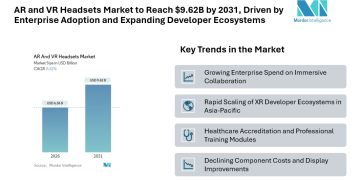
According to Mordor Intelligence, the AR and VR headsets market was valued at USD 5.86 billion in 2025 and is estimated to grow from USD 6.36 billion in 2026 to reach USD 9.62 billion by 2031, registering a CAGR of 8.62% during the forecast period. The rising AR and VR headsets market size reflects steady enterprise rollouts, improving optics efficiency, and supportive industrial policies across major economies.
While gaming continues to anchor consumer demand, the industry is seeing a visible shift toward professional deployments. A growing share of enterprises now operates live immersive deployments, influencing product roadmaps, security frameworks, and software compatibility.At the same time, falling component costs and improving display performance are expanding the addressable base, supporting long-term market growth. However, supply-side bottlenecks and data privacy regulations remain key considerations within the AR and VR headsets market forecast.
AR and VR Headsets Market Trends
Growing Enterprise Spend on Immersive Collaboration
Enterprise adoption has become a defining AR and VR headsets market trend. Companies are integrating headsets into inspection workflows, onboarding programs, safety simulations, and remote audits. Demonstrated improvements in productivity and defect reduction have encouraged multi-year procurement cycles. Vendors are bundling device management tools, compliance-ready security stacks, and plug-ins for widely used collaboration suites.
Rapid Scaling of XR Developer Ecosystems in Asia-Pacific
China and South Korea are witnessing rapid expansion in XR content creation. A large number of new VR projects launched recently in mainland China, often blending localized storytelling with immersive tourism experiences. In South Korea, domestic brands are pricing competitively while offering tailored content packs. This ecosystem effect—where device sales support developer revenue and vice versa—strengthens regional AR and VR headsets market growth.
Healthcare Accreditation and Professional Training Modules
Healthcare is emerging as a major vertical within the AR and VR headsets industry. Formal accreditation for immersive surgical simulation modules is changing VR from an optional training tool to a budgeted requirement. Hospitals and medical colleges are integrating immersive learning into curricula, expanding the market size beyond entertainment. Specialized devices with medical-grade features are entering procurement pipelines, further diversifying AR and VR headsets market share across applications.
Declining Component Costs and Display Improvements
Advances in pancake optics and micro-OLED displays are reducing bill-of-materials costs. Improved brightness levels and thinner display modules enable lighter headsets with improved comfort. As average selling prices moderate, access widens in emerging regions.This cost elasticity supports broader market growth, particularly in Latin America, Southeast Asia, and Eastern Europe.
Data Privacy and User Comfort Challenges
Regulatory scrutiny around biometric eye-tracking data is shaping monetization models, particularly in Europe. Compliance requirements are influencing application development strategies and advertising approaches within the AR and VR headsets industry. In addition, user discomfort and cybersickness remain factors impacting consumer session length. Addressing these issues will be central to sustaining AR and VR headsets market trends across both consumer and enterprise segments.
Check out more details and stay updated with the latest industry trends, including the Japanese version for localized insights: https://www.mordorintelligence.com/ja/industry-reports/ar-and-vr-headsets-market?utm_source=emailwire
AR and VR Headsets Market Segmentation
By Device Type
- Augmented Reality (AR)
- Optical See-Through
- Video See-Through
- Virtual Reality (VR)
- Semi-Immersive
- Fully Immersive
- Mixed Reality (MR)
- Pass-Through
By Product Type
- Standalone Headsets
- Tethered / PC-Connected Headsets
- Smartphone-Enabled Headsets
- Hybrid XR Headsets
By Price Tier
- Low-End (Less than USD 199)
- Mid-Range (USD 200 – 499)
- Premium (More than USD 500)
By Component
Hardware
- Optics
- Fresnel
- Pancake
- Waveguide
- Display Technology
- LCD
- AMOLED
- Micro-OLED
- MicroLED
- Processing and Connectivity Chipsets
- Sensor Suite
- IMU
- Eye Tracking
- Depth Sensors
- Hand Tracking
- Power and Battery Modules
Software
- Runtime OS and SDKs
- Content and App Stores
By End-User
- Consumer
- Enterprise
By Application
- Gaming and Entertainment
- Healthcare and Medical Training
- Education and Workforce Training
- Retail and E-commerce Visualization
- Manufacturing and Industrial Maintenance
- Defense and Aerospace Simulation
- Real Estate and AEC Visualization
By Distribution Channel
- Online
- Storefront
- Direct-to-Consumer (DTC)
- Offline
- Consumer Electronics Stores
- Enterprise Value-Added Resellers (VARs)
By Geography
North America
- United States
- Canada
- Mexico
Europe
- Germany
- United Kingdom
- France
- Nordics
- Rest of Europe
South America
- Brazil
- Rest of South America
Asia-Pacific
- China
- Japan
- India
- South-East Asia
- Rest of Asia-Pacific
Middle East and Africa
Middle East
- Gulf Cooperation Council (GCC) Countries
- Turkey
- Rest of Middle East
Africa
- South Africa
- Rest of Africa
Explore Our Full Library of Technology, Media and Telecom Research: https://www.mordorintelligence.com/market-analysis/technology-media-and-telecom?utm_source=emailwire
AR and VR Headsets Market Key Players
- Meta Platforms, Inc.
- Sony Group Corporation
- HTC Corporation
- Microsoft Corporation
- Samsung Electronics Co., Ltd.
Conclusion
The AR and VR headsets market is transitioning from a primarily gaming-focused segment to a diversified ecosystem spanning enterprise collaboration, healthcare training, industrial inspection, and immersive retail. The AR and VR headsets market size is expanding steadily, supported by enterprise procurement cycles and improving component economics.
Although supply constraints and regulatory compliance requirements present challenges, the broader AR and VR headsets market forecast remains positive. Balanced demand across consumer and enterprise categories, regional ecosystem development, and declining hardware costs will continue shaping AR and VR headsets for market trends.
Industry-Related Reports
Smart Television and Set-Top Box Market
The smart television and set-top box market is projected to grow from USD 327.22 billion in 2025 to USD 334.82 billion in 2026 and reach USD 375.74 billion by 2031, at a CAGR of 2.32% during 2026–2031. Growth is driven by rising adoption of connected TVs, expansion of OTT streaming platforms, and increasing demand for integrated entertainment ecosystems with advanced features such as voice control and AI-based content recommendations. The shift toward high-resolution displays and smart home integration is further supporting market expansion.
The audio amplifier market was valued at USD 4.07 billion in 2025 and is estimated to grow to USD 4.26 billion in 2026, reaching USD 5.32 billion by 2031, at a CAGR of 4.58% over the forecast period. This growth is fueled by increasing demand for high-quality sound systems in home entertainment, automotive infotainment, and professional audio applications, along with advancements in compact, energy-efficient amplifier technologies. Rising consumer interest in immersive audio experiences and premium audio equipment is also contributing to market growth.
Wireless Audio Device Market Share
The wireless audio device market is estimated at USD 60.4 billion in 2026, up from USD 57.48 billion in 2025, and is projected to reach USD 77.32 billion by 2031, registering a CAGR of 5.07% during 2026–2031. Market expansion is driven by the growing popularity of true wireless stereo (TWS) earbuds, increasing smartphone penetration, and consumer preference for portable, cable-free audio solutions. Technological advancements such as Bluetooth improvements, noise cancellation, and smart assistant integration are further accelerating adoption.
About Mordor Intelligence:
Mordor Intelligence is a trusted partner for businesses seeking comprehensive and actionable market intelligence. Our global reach, expert team, and tailored solutions empower organizations and individuals to make informed decisions, navigate complex markets, and achieve their strategic goals.
With a team of over 550 domain experts and on-ground specialists spanning 150+ countries, Mordor Intelligence possesses a unique understanding of the global business landscape. This expertise translates into comprehensive syndicated and custom research reports covering a wide spectrum of industries, including aerospace & defense, agriculture, animal nutrition and wellness, automation, automotive, chemicals & materials, consumer goods & services, electronics, energy & power, financial services, food & beverages, healthcare, hospitality & tourism, information & communications technology, investment opportunities, and logistics.
For any inquiries or to access the full report, please contact:
media@mordorintelligence.com
https://www.mordorintelligence.com/
Mordor Intelligence, 11th Floor, Rajapushpa Summit, Nanakramguda Rd, Financial District, Gachibowli, Hyderabad, Telangana – 500032, India