






Lactose-Free Milk Market Size and Growth Outlook
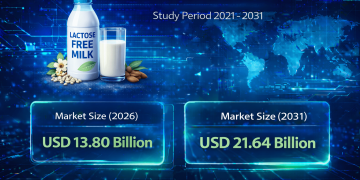
According to a research report by Mordor Intelligence, the global lactose-free milk market size is valued at USD 13.80 billion in 2026 and is projected to reach USD 21.64 billion by 2031, reflecting strong growth during the forecast period.
The steady lactose-free milk market growth is primarily driven by:
- Increasing prevalence of lactose intolerance
- Rising consumer awareness of digestive health
- Expansion of the “free-from” product category
- Growing availability across retail and online channels
The Lactose-Free Milk Industry is expanding across North America, Europe, and the Asia-Pacific. Liquid formats dominate due to convenience and ready-to-drink appeal, while flavored and reduced-fat options are gaining traction among younger and health-conscious consumers.
Access detailed segmentation and competitive insights: https://www.mordorintelligence.com/industry-reports/lactose-free-milk-market?utm_source=emailwire
Key Trends Shaping the Lactose-Free Milk Market
1. Rising Prevalence of Lactose Intolerance
Lactose malabsorption affects a large share of the global population, particularly in Asia, Africa, and parts of Europe.
Countries such as China, India, and South Korea report high intolerance rates, creating sustained demand for lactose-free dairy alternatives. As awareness improves, more consumers are proactively choosing lactose-free milk—even without clinical intolerance—supporting continued lactose-free milk market share expansion.
2. Growing Focus on Digestive Health and “Free-From” Products
The “free-from” movement has expanded beyond gluten to include lactose-free dairy.
Consumers increasingly associate digestive wellness with overall health and preventive nutrition. As a result, manufacturers are enhancing value by fortifying lactose-free milk with:
- Calcium
- Vitamin D
- Probiotics
- Prebiotics
These nutritional enhancements strengthen premium positioning within the lactose-free milk market forecast.
3. Product Innovation and Flavor Expansion
Flavored lactose-free milk variants—such as chocolate, vanilla, and strawberry—are gaining popularity, particularly among children and younger adults.
Reduced-fat and fat-free formulations are also expanding, supported by rising interest in heart health and weight management. Advanced processing technologies like ultrafiltration and enzyme treatment improve taste and texture, narrowing the sensory gap with traditional dairy milk.
Explore region-specific insights, including Japan: https://www.mordorintelligence.com/ja/industry-reports/lactose-free-milk-market?utm_source=emailwire
Lactose-Free Milk Market Segmentation
By Product Type
- Liquid (dominant segment)
- Powder
Liquid formats maintain leadership due to convenience and widespread retail presence.
By Fat Content
- Whole Milk
- Semi-Skimmed / Low-Fat Milk
- Skimmed / Fat-Free Milk
Low-fat and fat-free variants are witnessing higher growth due to health-conscious consumption patterns.
By Category
- Plain
- Flavored
Flavored lactose-free milk is expanding rapidly within the youth and family segments.
By Packaging Type
- PET Bottles
- Glass Bottles
- Cartons
- Others
Carton packaging remains popular for shelf stability and sustainability considerations.
By Distribution Channel
- HoReCa (Hotels, Restaurants, Catering)
- Retail
- Supermarkets and Hypermarkets
- Convenience Stores
- Specialty Stores
- Online Retail
Online retail is growing steadily as consumers prioritize home delivery and subscription models.
By Geography
North America – Mature market with high awareness and strong retail penetration
Europe – Strong dairy tradition combined with growing digestive health focus
Asia-Pacific – High lactose intolerance prevalence driving rapid growth
South America – Expanding middle-class consumption
Middle East and Africa – Gradual adoption supported by modern retail expansion
Explore the Food & Beverage research library: https://www.mordorintelligence.com/market-analysis/food-beverage?utm_source=emailwire
Competitive Landscape
The lactose-free milk market is moderately consolidated, with leading players investing in processing technology, fortification, and global distribution.
Lactose-Free Milk Market Key Players Include:
- Arla Foods amba – Broad lactose-free portfolio with fortified options
- Organic Valley – Organic and flavored product offerings
- The Coca-Cola Company – Expanding dairy alternatives via partnerships
- Nestlé S.A. – Focused on ultrafiltration and premium innovation
- Fonterra Co-operative Group – Leveraging global dairy supply chains
Competitive strategies focus on:
- Nutritional fortification
- Flavor diversification
- Premium positioning
- Regional expansion
- Sustainable packaging solutions
Conclusion
The lactose-free milk market forecast indicates continued expansion through 2031, supported by rising lactose intolerance awareness, growing digestive health consciousness, and ongoing product innovation.
As consumers increasingly prioritize nutrition, taste, and digestive comfort, lactose-free milk is transitioning from a niche alternative to a mainstream dairy category. Companies that successfully balance flavor, fortification, and affordability are expected to strengthen their lactose-free milk market size and share in the coming years.
Industry Related Reports
Cheese Market – The global cheese market is projected to grow from USD 171.89 billion in 2026 to USD 219.07 billion by 2031, driven by rising consumer demand for processed and specialty cheeses, increasing adoption in foodservice and retail sectors, and growing preference for protein-rich diets. The expansion of organized retail and innovative product offerings are further fueling market growth.
Dairy Cream Market– The dairy cream market, valued at USD 11.37 billion in 2026, is expected to reach USD 13.67 billion by 2031, supported by rising demand in bakery, confectionery, and beverage applications, as well as consumer inclination toward premium dairy products. Increasing health awareness and innovations in low-fat and flavored creams are key growth drivers.
Dairy Snack Market – The dairy snack market is estimated at USD 266.7 billion in 2026 and projected to reach USD 346.24 billion by 2031, fueled by the growing trend of on-the-go snacking, rising health-conscious consumers seeking protein-rich options, and product diversification in flavors and formats. Retail expansion and convenience-oriented packaging are also boosting the market.
About Mordor Intelligence:
With a team of over 550 domain experts and on-ground specialists spanning 150+ countries, Mordor Intelligence possesses a unique understanding of the global business landscape. This expertise translates into comprehensive syndicated and custom research reports covering a wide spectrum of industries, including aerospace & defense, agriculture, animal nutrition and wellness, automation, automotive, chemicals & materials, consumer goods & services, electronics, energy & power, financial services, food & beverages, healthcare, hospitality & tourism, information & communications technology, investment opportunities, and logistics.
For any inquiries, please contact: